
Between A Rock And A Shared Space

Sometimes, if you really want people to remember something, you have to catch them off-guard. A prepared and expectant audience is potentially just an echo chamber, you may get some comforting assurances in return for your efforts, but it may never be more than pruning a tree that will fruit regardless of your attempts to help it produce a richer crop.
The alchemical power of creative practice is to make the very stones cry out, to turn rocks into trees by creating in them a thirst for water.
But be careful making assumptions with the deliberately dramatic image I’ve chosen here, because that rock is not going to have the first fucking clue what to do when it wakes up in an orchard for the first time.
Members of my family returning from a Saturday shopping foray in December related an amusing incident where a middle aged man in the lift with them muttered ‘Oh darn it, I forgot to bring my machine gun and my machete. Oh well, everybody ready?’ before his wife added with emphasis ‘Into the breach!’ just before the door opened at ground level and released them into the seasonal melee of the shopping centre. While both my wife and daughter entered easily into the good humour of the moment, there was a pair of Easter Island statues in the opposite corner of the elevator whose faces refused to crack. The easy thing to do would be to write them off as a pair of humourless coots and move on, but when we consider the growing levels of callousing British society suffers from, this is the audience in dire need of transformation.
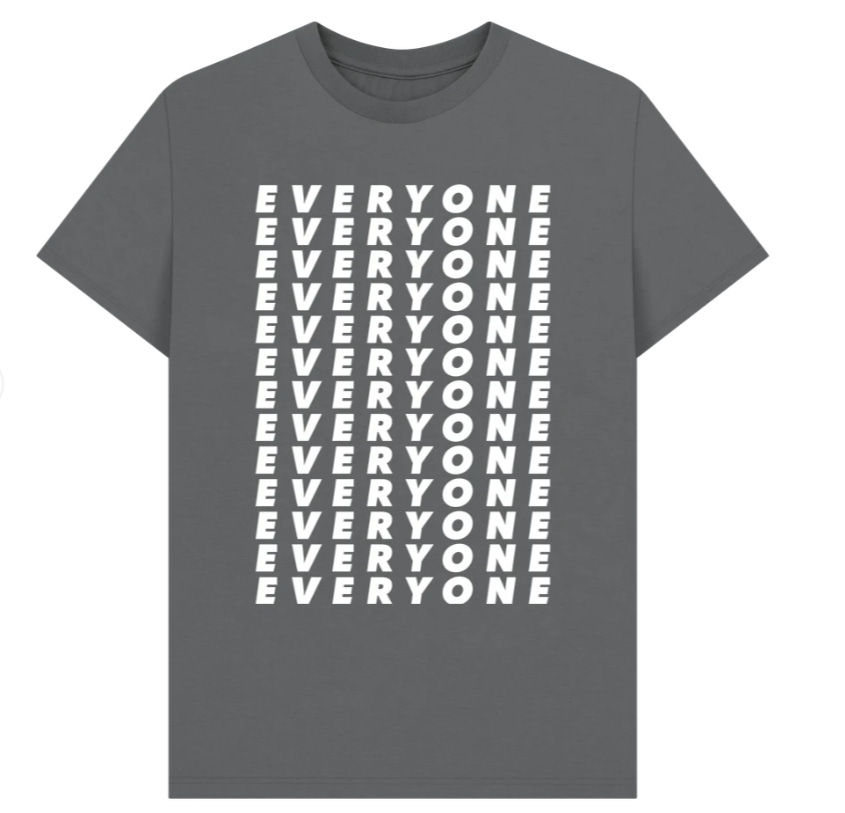
With reference to a deceptively simple message displayed on a t-shirt designed by one of my favourite Mancunians Micah Purnell, which simply repeats the word ‘Everyone’ several times on the front, and unless you have a morally convenient way to dispose of people you don’t like, society needs positive engagement from all of us. We need people investing in the perpetuation of all forms of greed, neglect, prejudice, hatred and violence to stop - we need ‘Everyone.’
This is where the faith element of creativity is crucial, because it’s about working to communicate human ideas in a way that has the potential to influence the thoughts and subsequent behaviour of others.
Micah’s accommodation of this thought in the messages he crafts is not coincidental, and is heavily influenced by the criticism of Hans Rookmaaker who said this of creative practice:
“Art’s problems are society’s problems. We cannot wait until the whole of society has changed, we have to work now. No renewal movement will ever work unless the artist is there, they’ve got to go ahead of it. The artist has been in the underground in the protest against technocracy, so they are entitled to go ahead.
They have to create the songs, the poems, the images, the metaphors, the books, the fictions that would make the new ideas clear, that would make what is not obvious, obvious. I’m not talking about easy things, we want things too cheap, economically, culturally and spiritually.”
Put more succinctly by Brian Eno when delivering the John Peel Lecture of 2015, “the role of the artist is to imagine an alternative future.”
So, what makes creative practice of indispensable importance to the health of a society is encounters with a clueless audience. That stony faced couple in the lift who don’t even know how to react when an alternative is presented.
One of my most memorable experiences of being ‘the shitheads in the lift’ as we will henceforth refer to them, was when I first encountered Grimm’s Tales in their original form. Having been brought up in a culture where the only purpose of storytelling is an ersatz moral homogeneity, I had no idea how to react to the complete absence of clear conclusions in such a large volume of tales. Instinct told me it was important, but I had no mental apparatus through which to engage with the content. And because I had absolutely no idea what they meant, it was a while before I developed the ability to even react.
The moment I woke up in this particular orchard came a couple of years later when I commented to my great friend the poet and storyteller Jez Green about how pointless and boring I’d found a collection of Scottish folk takes. Jez took a moment to explain that the historical function of such stories was often just a place in which to store the wisdom of the time, the goal was to make tales memorable enough to be retold, not to ‘make sense’ by prevalent Western standards in the 21st century. This means my boredom was a symptom of a blindness imposed on me by living in the deceptively verdant desert of a post-modern monoculture, and Jez’s words were the medicine needed to help me see a path towards the alternative future I now live in.
With this in mind, I think it’s great when an audience knows a bit about what’s coming and how it’s going to be delivered, but breaking in new audiences is at least as important. This is where I find another great friend and fellow writer Allistur Cranston an essential companion, because my default is always to devise an environment in which poetic expression and storytelling can be heard and absorbed ‘properly,’ which really means in a way where I have a good level of reciprocity from those gathered, where the audience becomes participant instead of dumb listener. Allistur couldn’t give a shit about that, his attitude is totally Gonzo - ‘just fucking read it, Rory!’
For me, this approach is always less comfortable and less satisfying unless my faith in what I believe my work can achieve is in tip top shape. This is because the reciprocity I hope for and keenly want takes a lot longer to turn up, and with considerably less predictability. Like my chance encounter with a guy who couldn’t read printed material because of his PTSD, but was so blindsided by finding a poem I’d hung anonymously by a remote public footpath that he read the whole thing before realising it. I genuinely don’t know which of us was more delighted.
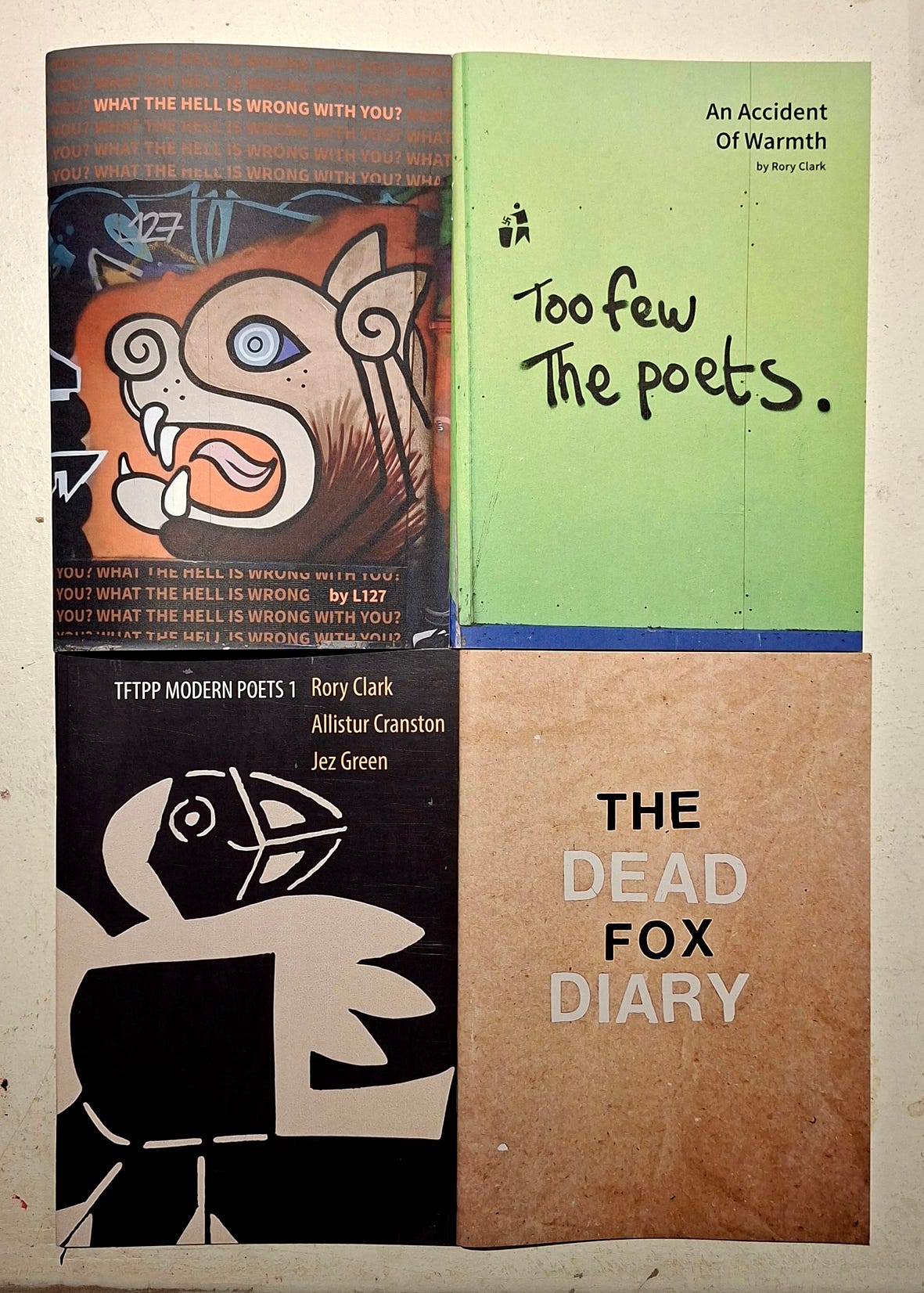
Following Allistur’s policy of taking every opportunity to read for any audience instead of my more selective approach is the ingredient in Too Few The Poets Press that has seen us publish 25 zines since December 2024 and the selling out of our first public social event in November of this year. An event largely attended by people in the embryonic stages of their encounter with poetic expression, and the storyteller’s art.
On the one hand it’s plain wrong to muzzle the ox while it treads out the grain - when we work hard at creative practice, it’s natural to want a share in the benefit our labour brings to others. But getting used to the health and comfort good creative community produces through thoughtfully curated spaces and predisposed audiences risks denying ourselves experiences where the value of our work is at its most powerful.
This is a big, bold idea. I realise I have very little faith that people not already predisposed towards artistic expression, or at least to curious dialogue, will ever be meaningfully reached by my work. Not sure how to crack that one. Yet.
This sentence portion: "my boredom was a symptom of a blindness imposed on me by living in the deceptively verdant desert of a post-modern monoculture" speaks volumes. Love it!